










“My teeth are in such bad shape, I'd like a full consultation.”
Hello.
I aim for treatment that stays comfortable for years,
so you don't have to come back for the same problem.
Board-certified specialist in Advanced General Dentistry (Korea)
Boston Miso Dental Clinic, Uijeongbu
I'm Dr. Jongbum Lee.
💡 Key Answer
Full-arch implants don't mean the upper and lower jaws are treated the same way. If the implants hold firmly enough in the bone, temporary teeth can be attached soon after placement, but in areas that also need a bone graft, it's better to protect the implants under the gum and wait until they fully fuse with the bone. In this case, fixed temporary teeth were attached in the lower jaw within a week of placement, while the upper jaw needed bone grafting, so we waited and used a removable temporary denture. Dr. Jongbum Lee's approach at Boston Miso Dental Clinic — move quickly where the bone holds firm, and wait where waiting is needed.
This case at a glance
The exam showed that periodontal disease had progressed significantly around most of the upper and lower teeth, and the remaining teeth would be hard to keep long-term.
So we removed the teeth and proceeded with full-arch implant treatment. After placing six implants in the lower jaw, we checked how firmly they held in the bone and attached fixed temporary teeth within a week of placement. The patient was without any teeth for no more than a week.
The upper jaw, on the other hand, needed bone grafting where bone was lacking. So we chose to protect the implants under the gum and wait until they fully fused with the bone. After the teeth were removed, the patient went without upper teeth for about two weeks, and has since been using a removable temporary denture.
Dr. Jongbum Lee's approach — the upper and lower jaws aren't treated the same way. If the bone holds firm, temporary teeth are attached within a week; if bone grafting is needed, we wait. We don't rush where waiting is needed.
Diagnosis and treatment plan
When periodontal disease progresses over a long period, the gum and surrounding bone that hold the teeth in place can weaken. This can cause teeth to loosen or shift position, and the way the upper and lower teeth bite together can also be thrown off.
This patient, too, had severe periodontal disease around most of the upper and lower teeth, and rather than treating and keeping just a few teeth, we needed to look at an overall treatment plan.

26.7.13
Above all, this patient came to us on a friend's recommendation. Facing the major decision of having many teeth extracted and both jaws treated, they trusted us with their care, and we were very grateful. We didn't take that lightly, and planned each step carefully, keeping in mind the discomfort the patient might go through along the way.

26.7.13
The exam showed that most of the teeth would be hard to keep long-term, so we planned full-arch implant treatment. However, because the bone condition differed between the upper and lower jaws, we didn't proceed with the same method for both.
We judged that in the lower jaw, the implants would hold relatively firmly in the bone once placed. So we planned “immediate loading,” attaching temporary teeth within a week of placement.
An implant is a bit like a post set into the bone. If the post is firmly anchored from the start, temporary teeth can be attached even while waiting for the implant to fully settle in.
The temporary teeth used here aren't a denture the patient takes out and puts back in — they're a single piece joined to several implants. These are called “fixed temporary teeth.”
The upper jaw was a different situation. There wasn't enough bone to place implants, so bone grafting was needed as well, and it was important to allow enough time for the grafted area to heal securely.
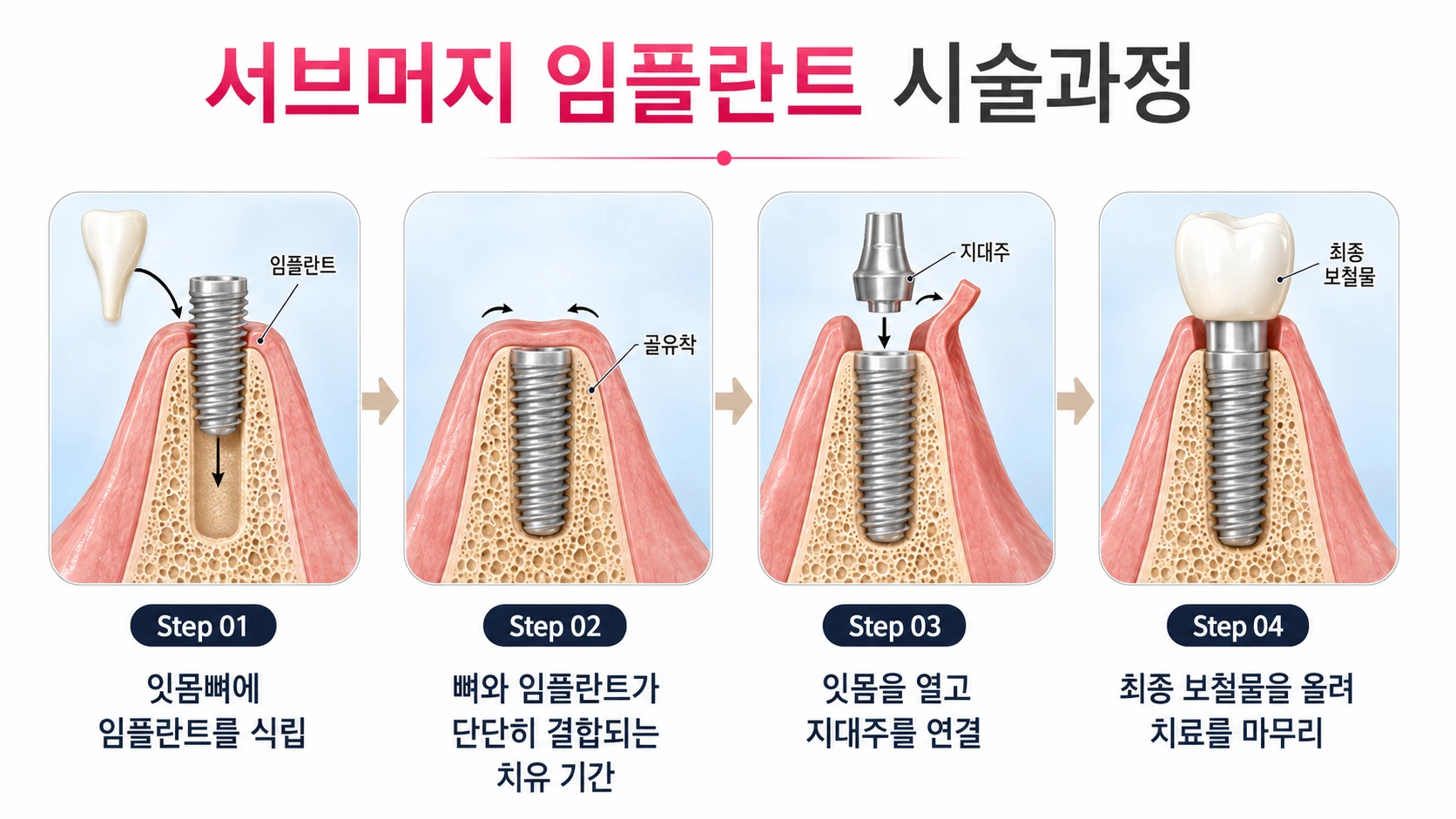
AI-generated image for illustration — the submerged method. During the healing period in ②, the implant is covered by the gum and can't be seen, which is why step ③ requires reopening the gum to connect the abutment.
So in the upper jaw, rather than attaching teeth right after implant placement, we used the “submerged” method — protecting the implants beneath the gum while waiting for them to fuse with the bone.
Think of it like giving a newly planted tree time to settle into the soil and take root without being disturbed. When an implant also needs time to fully fuse with the bone, it's important to wait for stable healing rather than rushing to apply force.
Treatment process
1. We extracted the lower teeth and placed the implants
We first extracted six lower teeth that would have been difficult to keep long-term.

26.7.13
We then placed a total of six implants — in the lower right molar area, the front teeth, and the lower left molar area. In doing so, we first considered the overall balance so that chewing force wouldn't concentrate on one side. So we chose positions where the smallest number of implants could still distribute force evenly.
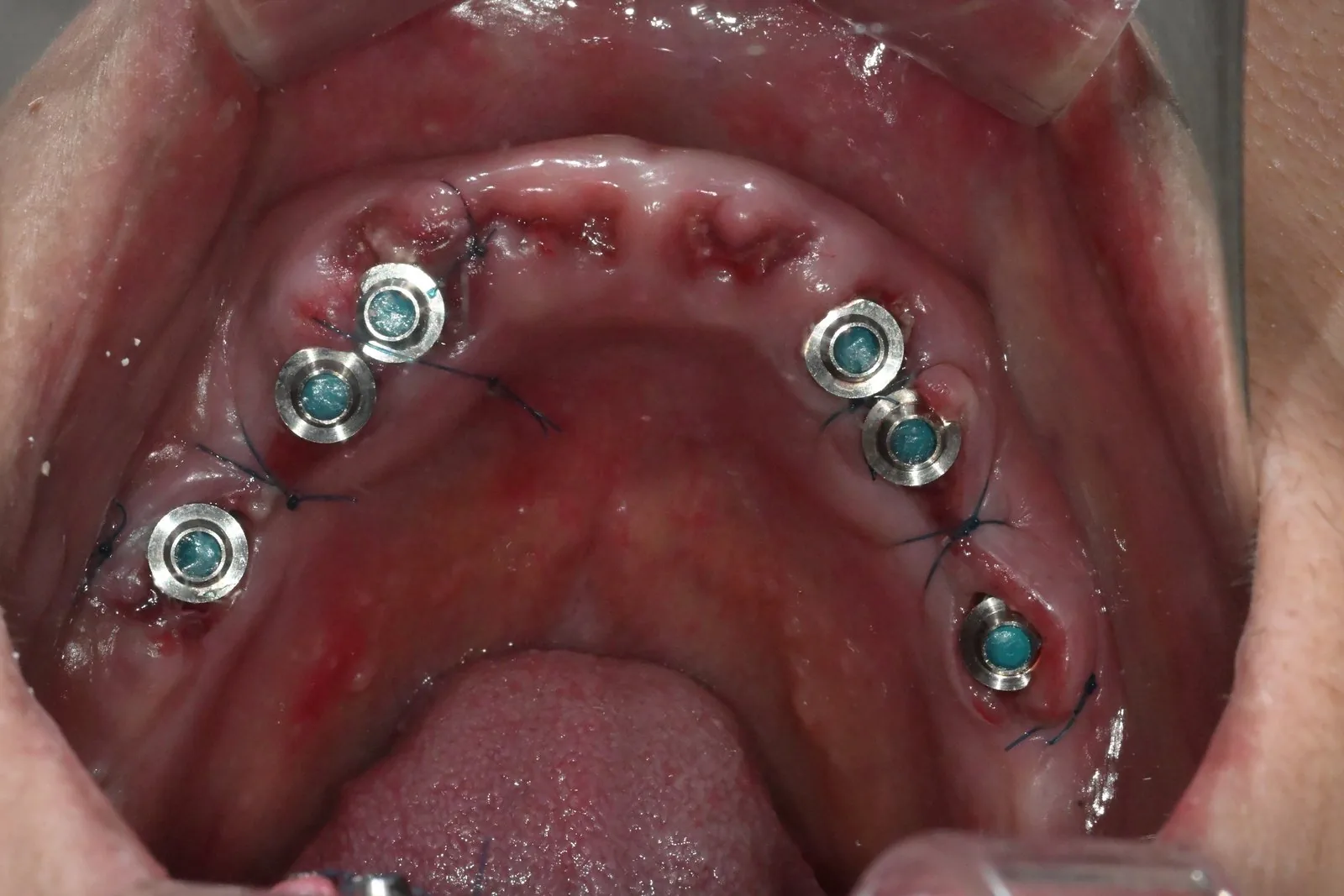
Jul 14, '26 — multi-unit abutments connected to the six lower-jaw implants
Right after placement, we first check how firmly each implant holds in the bone. If chewing force concentrates on just one implant, that spot can be overloaded. So instead of using each implant separately, we joined several implants with one-piece temporary teeth so the force would be spread evenly.
In other words, it's designed to share the load, the way several people carrying a heavy weight together is easier than one person carrying it alone.
2. We attached the lower temporary teeth within a week of placement
The day after surgery, we checked and disinfected the lower surgical site, then took a digital impression to make the temporary teeth. The same day, we also took the impressions and bite records needed to make the temporary denture for the upper jaw.
After taking the impression, we made one-piece PMMA temporary teeth for the lower implants. Once finished, the temporary teeth were attached to all six lower implants as a single unit within a week of implant placement.
Jul 16, '26 — 3 days after implant placement, lower fixed temporary teeth attached
Unlike an ordinary denture, these temporary teeth aren't taken out by the patient — they're a temporary restoration attached to several implants. Made of PMMA (a dental plastic), they stand in for the teeth during treatment and also serve as the key reference for the shape, bite (occlusion), and function of the final restoration.
This spared the patient a long stretch with no teeth at all after the extractions. That said, attaching temporary teeth quickly doesn't mean you can chew hard foods freely right from the start. Because the implants are still fusing with the bone, we advised the patient to avoid hard or chewy foods and to be careful not to put heavy force on the implants.
3. In the upper jaw, we performed bone grafting along with tooth extraction
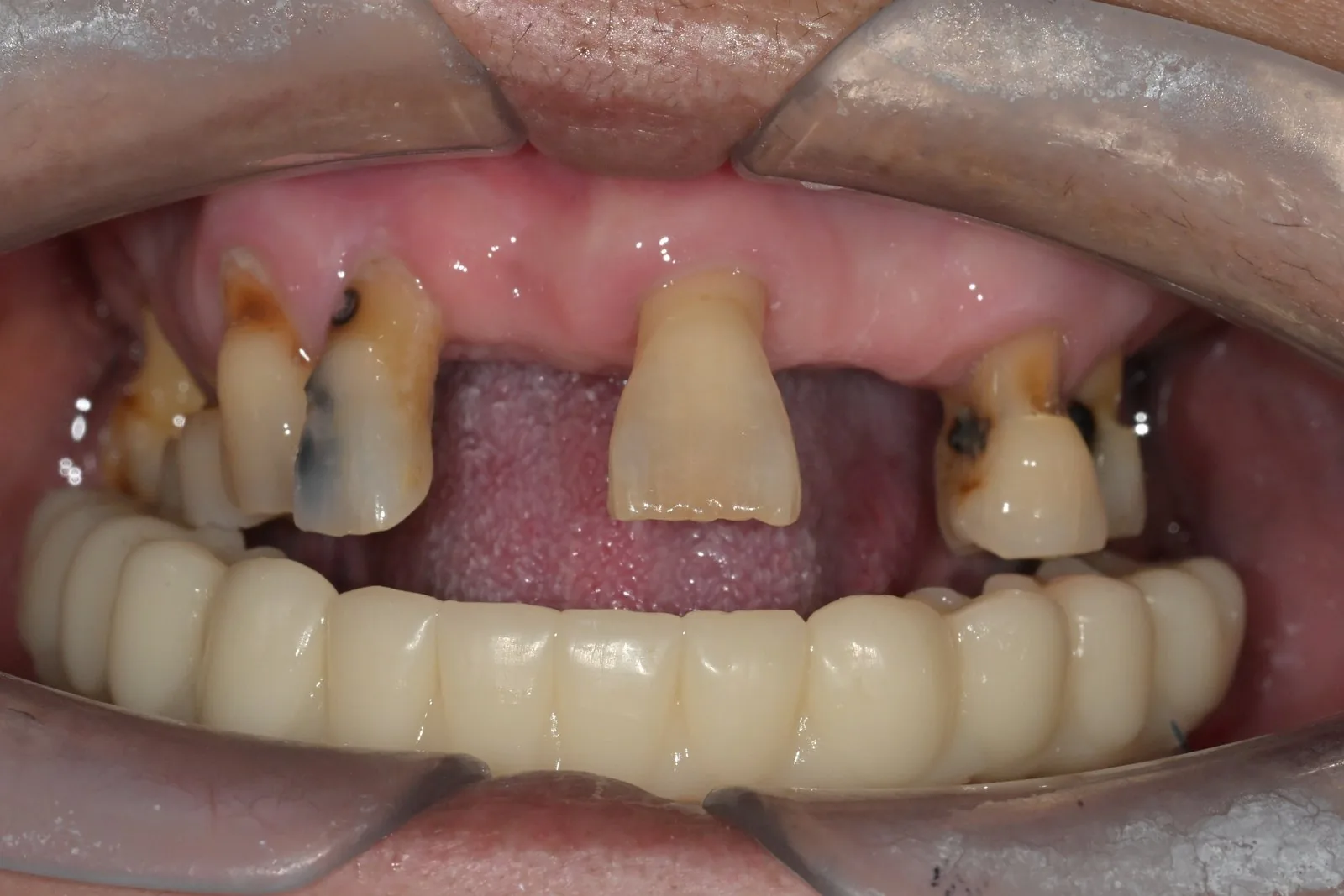
After first checking the bite and how well the patient was adjusting to the lower temporary teeth, we moved on to the upper jaw. Many of the upper teeth would have been hard to keep long-term, so a total of eight teeth were extracted.
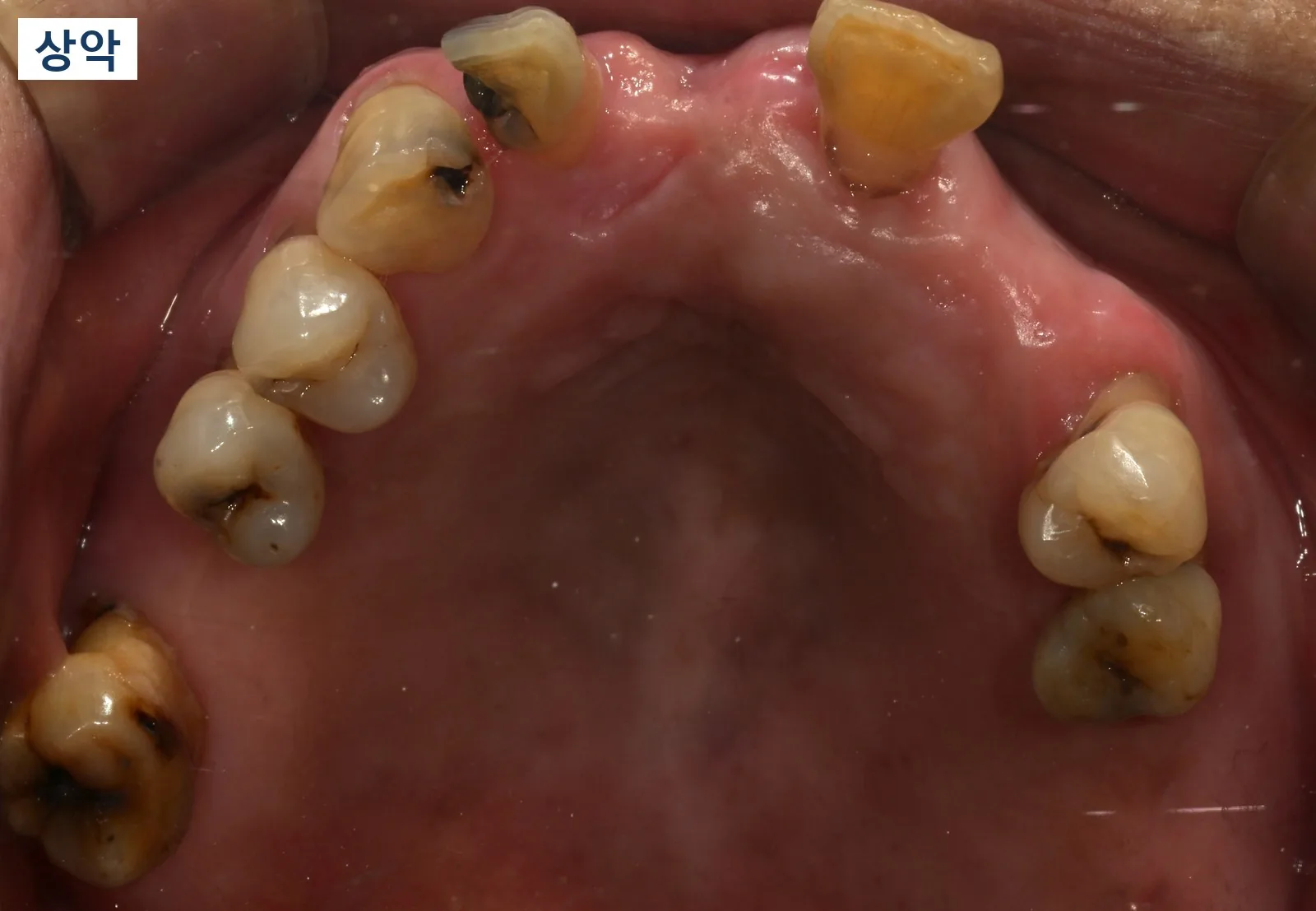
26.7.13
We then placed a total of seven implants in the upper right and left molar areas and the front teeth, to restore chewing function and overall balance in the upper jaw.
In the upper molar area, there wasn't enough bone height to place implants. This area has a space called the maxillary sinus — essentially an "empty air pocket" above the upper molars. The lower this space dips, the less bone height there is for an implant. So we also performed a sinus lift, carefully raising the sinus floor to make room for the implants.
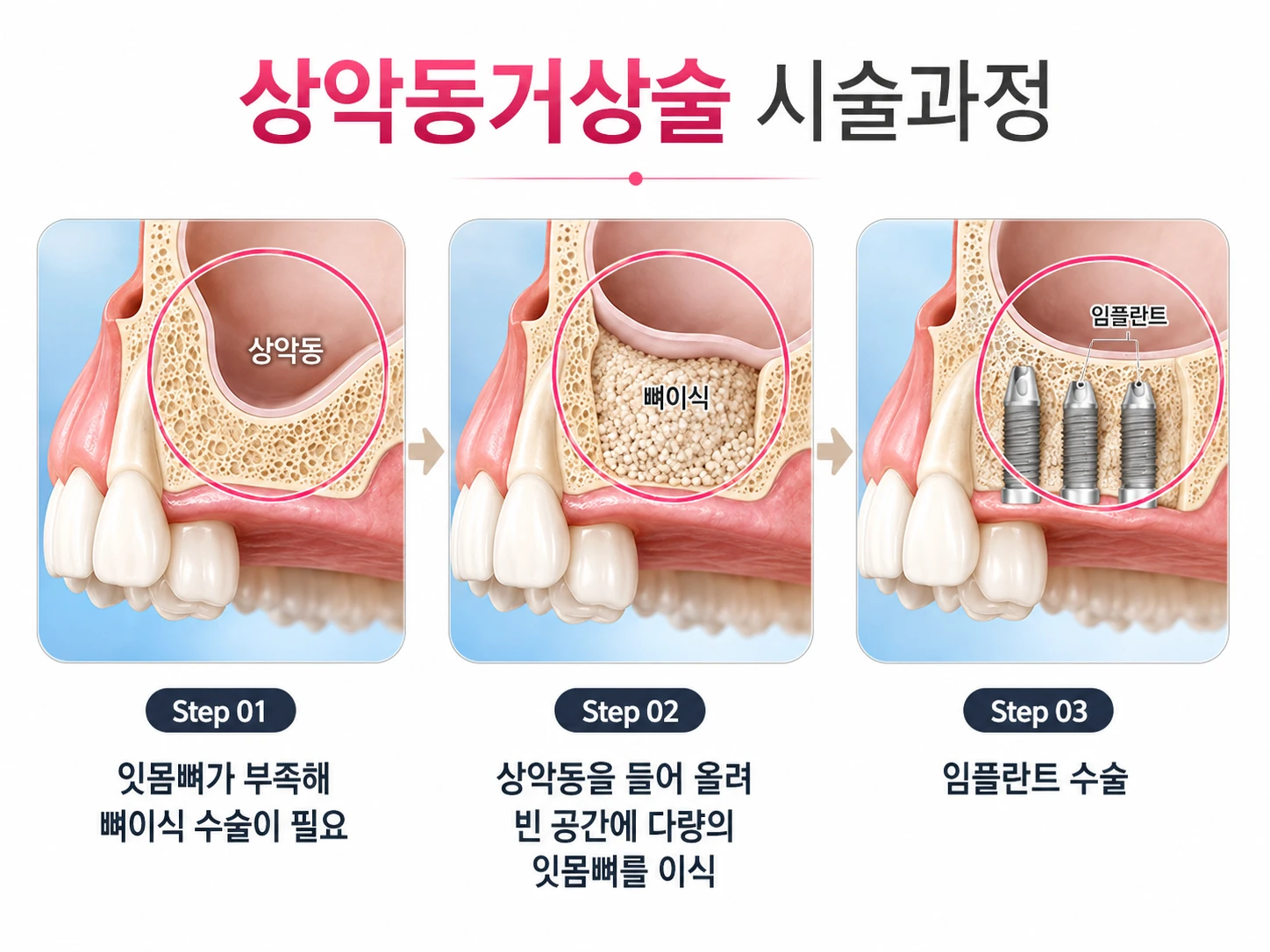
An AI-generated image for illustration — the sinus lift. The empty space (sinus) above the upper molars is carefully lifted, bone graft material is packed into the space created, and the implant is then placed into the bone secured this way.
We also performed guided bone regeneration (GBR) where bone was lacking, using bone graft material and a resorbable barrier membrane. The easiest way to think of guided bone regeneration is as "creating space" for missing bone to regrow. It first secures the space where bone needs to grow, then covers it with a membrane so other tissue doesn't move in first, giving the bone time to heal securely.
4. In the upper jaw, we're letting the implants heal before attaching teeth
Unlike the lower jaw, the upper jaw had bone grafting at the same time, so the implants and surrounding bone needed enough time to stabilize. So rather than attaching fixed temporary teeth right after placement, we finished the surgery with the implants covered by the gum to heal.
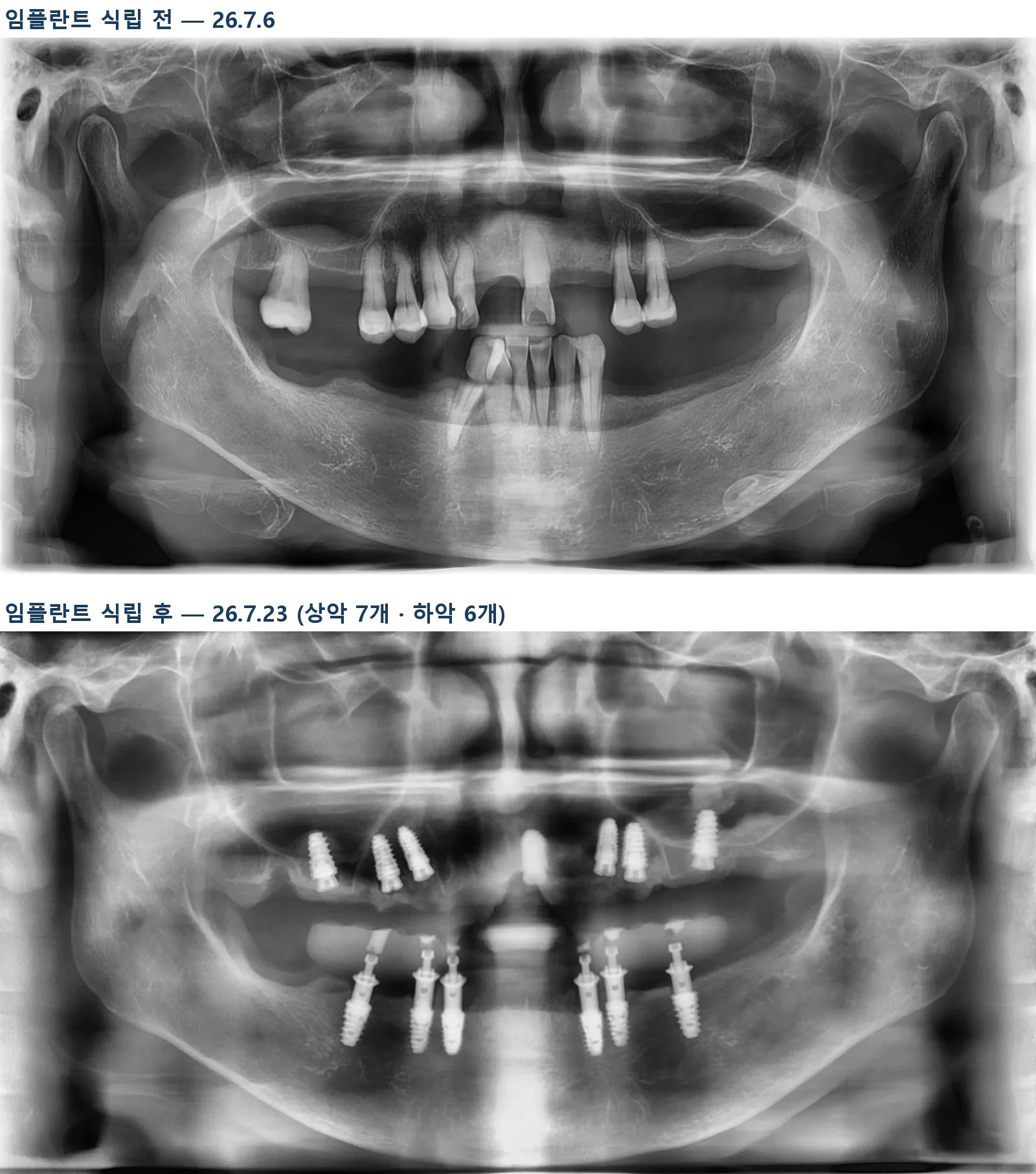
26.7.6 / 26.7.23
The upper temporary denture was fitted on Aug 7, '26, about two weeks after extraction and placement. Until then, the patient went without upper teeth, and is now using this temporary denture. Because it isn't fixed to the implants and can be taken out and put back in as needed, it can be worn while the grafted area and implants heal.
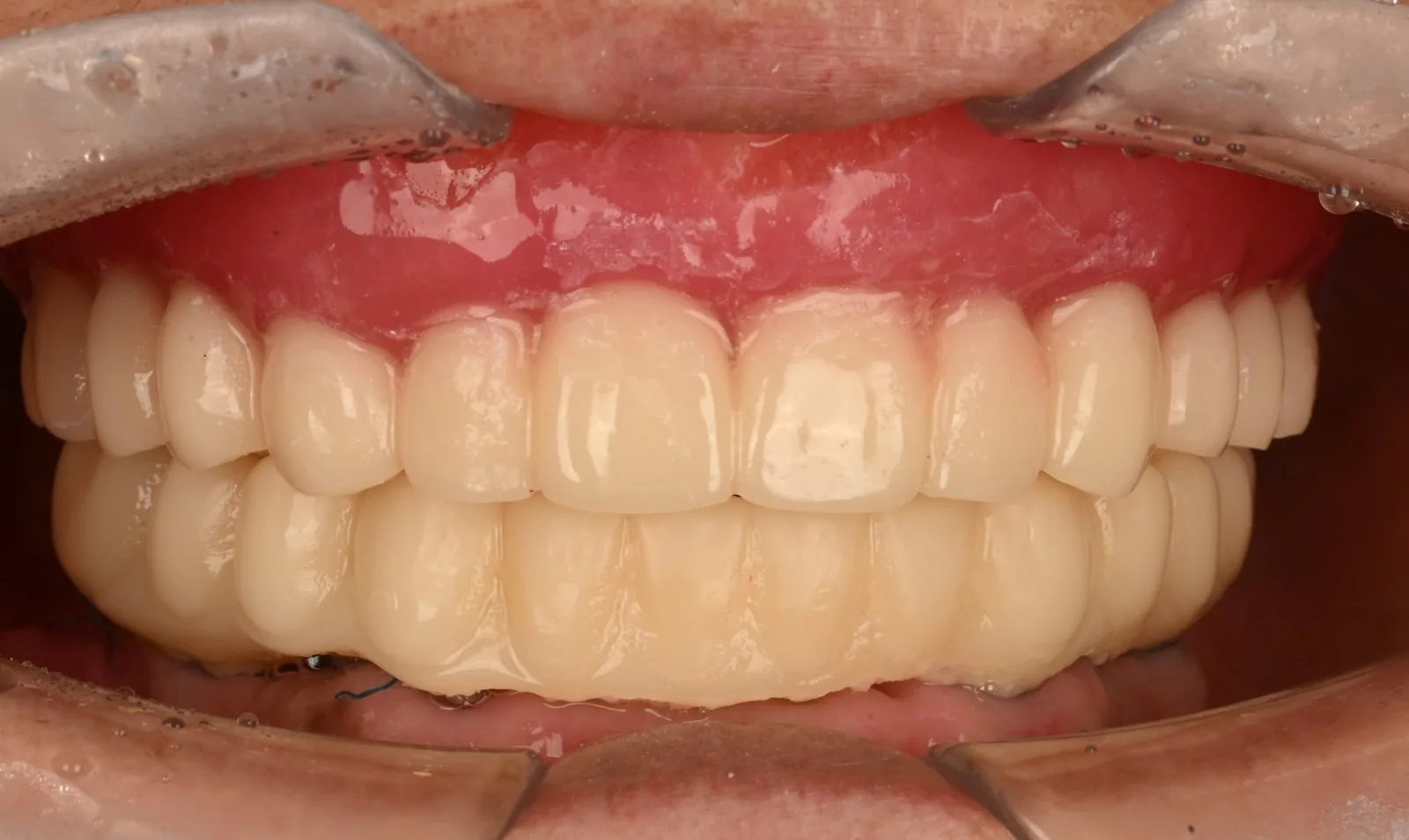
Aug 7, '26 — upper temporary denture fitted, meeting the lower fixed temporary teeth
Because the gums change shape gradually as they heal after surgery, we're checking and adjusting both where the temporary denture touches and how the upper and lower teeth bite together. Once sufficient osseointegration is confirmed, we plan a second surgery to uncover the upper implants healing beneath the gum, followed by the restorations.
Why the upper and lower jaws were treated differently in the same patient
Full-arch implants don't mean the upper and lower jaws are treated with a single method. When the bone conditions differ, the method and sequence differ too.
| Category | Lower Jaw (Mandible) | Upper Jaw (Maxilla) |
|---|---|---|
| Bone condition | Implants took hold relatively firmly | Insufficient bone height in the molar area — bone graft needed |
| Number placed | 6 implants | 7 implants |
| Procedures performed together | None | Sinus lift + guided bone regeneration (GBR) |
| Implant approach | Immediate loading — fixed temporary teeth attached within a week of placement | Submerged — protected beneath the gum while waiting for osseointegration |
| Time spent without teeth | Within 1 week (temporary teeth attached within a week of placement) | About 2 weeks (temporary denture fitted 15 days after extraction and placement) |
| Used during treatment | Fixed temporary teeth (PMMA, non-removable) | Temporary denture (removable) |
Treatment result
This full-arch implant treatment is still ongoing.
For the lower jaw, attaching fixed temporary teeth within a week of implant placement kept the time with no teeth at all under a week. The patient is now getting used to the temporary teeth in daily life.
For the upper jaw, since bone grafting was performed as well, waiting for recovery matters more than rushing. The patient is currently using a temporary denture while we continue to monitor whether the grafted area and implants are healing stably.
Going forward, we'll move to the next step once the upper implants are confirmed to have fully fused with the bone. After that, we plan to complete the final restorations step by step, checking that the upper and lower teeth bite together comfortably, that the gums are stable, and that force is spread evenly across the implants.
What is immediate loading? Attaching temporary teeth soon after placement
Immediate loading means attaching temporary teeth to the implants early, without waiting for them to fully fuse with the bone. For this patient's lower jaw, fixed temporary teeth were attached within a week of placement. It isn't suitable for every case, though, so we check the following conditions first.
✅ Can be considered
· When the implants are confirmed to hold firmly in the bone right after placement
· When several implants can be joined into one unit to share the load
· When there's enough surrounding bone in good condition
⚠️ Needs further evaluation
· When bone grafting was done at the same time — the grafted bone needs time to settle in first
· When a sinus lift is also needed
· Even with temporary teeth attached, you can't chew hard foods as usual from the start
In this case, the lower jaw fell under “can be considered,” and the upper jaw under “needs further evaluation.” Even in the same patient, if the upper and lower jaws differ, the method and sequence differ too.
Frequently asked questions
Q. With full-arch implants, can I have temporary teeth right after extraction?
Not every patient can have temporary teeth right away. We first need to check how firmly the implants hold in the bone at placement, and the amount and condition of the surrounding bone. For this patient too, temporary teeth were attached in the lower jaw within a week of placement, but in the upper jaw, which needed bone grafting, we're allowing enough healing time instead of attaching teeth right away.
Q. Why were temporary teeth attached right away in the lower jaw but not the upper?
Because the bone was different in the two jaws. In the lower jaw, the implants held relatively firmly from the start, so temporary teeth could be attached quickly; in the upper jaw, bone grafting was done at the same time, so the grafted bone and implants needed time to settle in securely. It's like building the same house on firm ground versus ground that needs a reinforced foundation — the construction method differs.
Q. What's the difference between fixed temporary teeth and a removable temporary denture?
Fixed temporary teeth aren't something you take out yourself — they're attached to the implants and stay in place. A removable temporary denture, on the other hand, can be taken out and put back in as needed. Here's a simple comparison of the two.
| Category | Fixed temporary teeth | Temporary denture |
|---|---|---|
| How it's worn | Firmly attached to the implants | Can be taken out and put back in as needed |
| Movement | Almost no movement | May shift slightly during use |
| Feel | Feels close to natural teeth | Feels like a removable denture |
| Force transfer | Force is shared across multiple implants | Some force is transferred to the gum |
| Purpose | Quickly restoring chewing function | Temporary use during the recovery period |
Q. Once temporary teeth are attached, can I eat normally right away?
Even with temporary teeth attached, it's best not to eat hard or chewy foods the way you normally would at first. While the implants are settling into the bone, avoid putting too much force on them.
Q. What should I check when getting a full-arch implant consultation in Uijeongbu?
Beyond whether your remaining teeth can be kept, it's worth checking the bone in both the upper and lower jaws, which areas need bone grafting, and what kind of temporary teeth you can use after the implants are placed. Even in the same patient, if the upper and lower jaws differ, treatment can proceed with different methods and timing, as in this case.
Q. With full-arch implants, how many months do I go without teeth?
It depends. If the implants need time to fuse with the bone, it can take several months, but if they're confirmed to hold firmly right after placement, immediate loading can shorten that period considerably. For this patient's lower jaw, fixed temporary teeth were attached within a week of placement, so the patient was without teeth for no more than a week. The upper jaw, where bone grafting was done at the same time, was different. For about two weeks after extraction and placement, the patient had no upper teeth; after that, a removable temporary denture was fitted and is still in use.
Q. What does it mean to say implants can be finished in a day?
It doesn't mean the entire implant treatment is finished in one day. It means temporary teeth are attached on the day of placement or soon after, restoring appearance and basic function first, while the implants continue fusing with the bone and the final restoration comes later. For this patient too, temporary teeth were attached in the lower jaw within a week of placement, but the final restoration will be made only after osseointegration is confirmed. At your consultation, it's best to ask separately “when will I get temporary teeth?” and “how long until the final restoration?”
Frequently searched questions
Q. Is there a dental clinic in Uijeongbu where I can consult about full-arch implants?
At Boston Miso Dental Clinic in Uijeongbu, we check the remaining teeth and the jawbone with panoramic X-rays and CT, then plan the approach for the upper and lower jaws separately. Depending on the bone, temporary teeth may be attached early or only after a waiting period.
Q. With full-arch implants, how long do I go without teeth?
If the implants hold firmly enough in the bone, fixed temporary teeth can be attached soon after placement — in this case, the patient was without lower teeth for no more than a week. Areas that need bone grafting, however, require a waiting period, during which a removable temporary denture can be used.
Q. Do the upper and lower full-arch implants have to be done at the same time?
Not necessarily. Because the bone condition and required treatment can differ between the upper and lower jaws, even for the same patient the method and timing may be split. The actual sequence is decided after examination.
Self-check before your visit
If you're consulting about full-arch implants, check whether you've been told about the following as well.
☐ Were you told the bone condition of each jaw, upper and lower?
☐ Have you confirmed which areas need bone grafting?
☐ Do you know what kind of temporary teeth you'll use during treatment? (fixed, or removable)
☐ Were you told how long you'll go without teeth?
☐ Were you told not just the number of implants but also where they'll be placed?
The third and fourth points affect daily life the most. It's better to ask about these before asking about the number of implants.
Related guides
With full-arch implants, the outcome depends less on the number and more on where and under what conditions they're placed.
· Implants — Diagnosis and Treatment-Planning Standards
· Jawbone Self-Check — 6 Questions to Answer Before Your Visit
· Gum Treatment — When Bone Has Been Lost to Gum Disease
· Cosmetic Crowns & Veneers — Final Restorations and Bite
You can also see other cases where the same reasoning was applied.
· A Case of Pain When Chewing on an Implant — Rebuilding the Bone First
· A Case of Remaking an Implant Crown — Addressing the Opposing Tooth First
Closing thoughts
When people hear "full-arch implants," many picture extracting all the teeth and placing several implants at once. But in actual treatment, it's just as important to plan the anatomical position and bone condition of each implant, which areas need bone grafting, and how the teeth will be used during the treatment period, as it is to decide how many implants to place.
Building on this patient's treatment experience, we will continue to do our best to diagnose and plan carefully so that every patient can be treated with the method best suited to their own oral condition. Rather than simply placing implants, we will continue treatment while carefully checking, at every step, the condition of the bone, the gum's healing process, and whether the upper and lower teeth come together naturally.
Throughout treatment, we'll also plan the temporary teeth and recovery so daily life is disrupted as little as possible, checking the patient's condition at every stage before moving forward.
Thank you.
Boston Miso Dental Clinic, Uijeongbu
Dr. Jongbum Lee, board-certified specialist in Advanced General Dentistry (Korea)
https://maps.app.goo.gl/UmdYCx18cpP9nmyk6
References
The decision criteria described in this article are based on the references below. Diagnosis and treatment outcomes vary with each patient's oral health.
- Gallucci GO, Benic GI, Eckert SE, Papaspyridakos P, Schimmel M, Schrott A, et al. Consensus statements and clinical recommendations for implant loading protocols. Int J Oral Maxillofac Implants. 2014;29 Suppl:287-90. doi:10.11607/jomi.2013.g4.
— A consensus statement summarizing the criteria and indications distinguishing immediate, early, and conventional loading - Papaspyridakos P, Mokti M, Chen CJ, Benic GI, Gallucci GO, Chronopoulos V. Implant and prosthodontic survival rates with implant fixed complete dental prostheses in the edentulous mandible after at least 5 years: a systematic review. Clin Implant Dent Relat Res. 2014;16(5):705-17. doi:10.1111/cid.12036.
— 5-year-plus survival rate of implant-fixed full-arch prostheses in the edentulous mandible - Pjetursson BE, Tan WC, Zwahlen M, Lang NP. A systematic review of the success of sinus floor elevation and survival of implants inserted in combination with sinus floor elevation. J Clin Periodontol. 2008;35(8 Suppl):216-40. doi:10.1111/j.1600-051X.2008.01272.x.
— A systematic review summarizing the survival rate of implants placed together with a sinus lift - Garcia J, Dodge A, Luepke P, Wang HL, Kapila Y, Lin GH. Effect of membrane exposure on guided bone regeneration: A systematic review and meta-analysis. Clin Oral Implants Res. 2018;29(3):328-338. doi:10.1111/clr.13121.
— An analysis finding that membrane exposure during guided bone regeneration reduces the amount of bone gained
#FullArchImplants #FullMouthImplants #UijeongbuImplants #UijeongbuDentist #BostonMisoDentalClinic #UpperJawImplants #LowerJawImplants #ImplantTreatment #ImplantBoneGraft #SinusLift #GuidedBoneRegeneration #ImmediateLoadingImplant #FixedTemporaryTeeth #TemporaryDenture #PeriodontalTreatment #FullArchImplant #EdentulousImplants #ImplantTimeline
So you never need treatment for the same reason again, our principle is to resolve the underlying cause as well. If you have a similar concern, feel free to come in for a consultation.
In articles covering case studies, the results shown are those of that patient; treatment methods, results, and duration can vary with each person's oral health. Any medical procedure can cause side effects, so a thorough consultation is needed before treatment.



 Minish