










General Dentistry 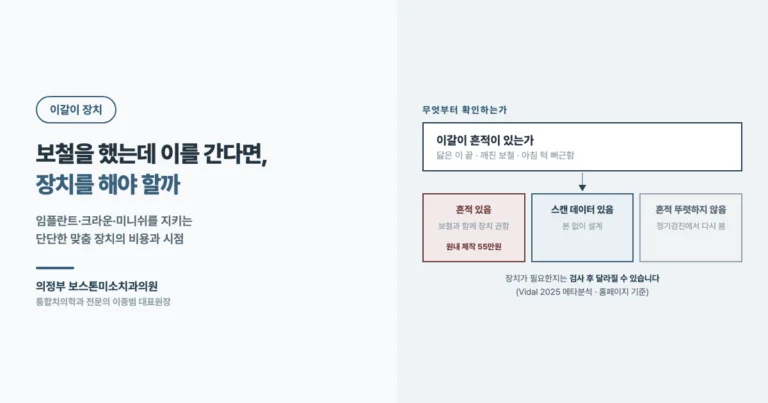
 TMJ
TMJ appliance (splint) · night guard — We make a custom hard appliance and take care of bite adjustments after fitting.
TMJ care at a glance — If your jaw hurts or makes sounds, we first determine whether the pain comes from the muscles or the joint. If an appliance is needed, we scan without impressions using an intraoral scanner and make a hard-resin appliance (splint). The first adjustment is 2–3 weeks after fitting, followed by bite readjustments at 2 weeks, 4 weeks, and 3 months. In-house fabrication costs ₩550,000 and external dental laboratory fabrication costs ₩600,000, including adjustment visits.
Two dentists certified in TMJ therapy distinguish muscle pain from joint pain, then make a custom hard appliance rather than a soft mouthguard. It is designed from an intraoral scan without impressions, and the appliance fee includes adjustments after fitting.
Dr. Jongbum Lee, Clinic Director (Board-Certified Specialist in Advanced General Dentistry (Korea)), and Dr. Juho Ryu, Associate Dentist, are both Certified in TMJ (Temporomandibular Joint) Therapy. We first determine whether the pain comes from the muscles or the joint, then design the appliance.
A soft appliance may make you chew on it while sleeping, which can put more strain on the jaw. That is why we make only hard-resin appliances with clear bite contacts.
We scan the upper and lower teeth and the bite with a 3Shape TRIOS intraoral scanner, then design the appliance digitally. Depending on its purpose and expected period of use, you can choose in-house 3D printing (₩550,000) or fabrication by an external dental laboratory (₩600,000).
As the muscles relax and the jaw settles into position with the appliance, the bite changes. The first adjustment is after 2–3 weeks, followed by further adjustments at 2-week, 4-week, and 3-month intervals depending on symptoms. Adjustment visits are included in the appliance fee.
Jaw stiffness in the morning, pain with joint sounds, and reduced mouth opening are signs that an appliance may be worth considering. A night guard protects teeth and restorations when teeth are wearing or breaking, when you have new implants or restorations, or when a ready-made mouthguard has been uncomfortable.
The examination determines whether the problem is in the muscles or the joint. If an appliance is needed, we design and make a hard appliance from an intraoral scan. We adjust the bite on fitting day, make the first readjustment after 2–3 weeks, and decide when to finish through reviews at 2 weeks, 4 weeks, and 3 months.
We check how far and along what path your mouth opens, joint sounds, muscle tenderness, and tooth wear or fractures. If needed, we examine the joints and teeth with 3D CT. For muscle pain, we first use medication, low-level laser therapy, and habit changes. We make an appliance if pain remains, the joint is involved, or there are signs of grinding.
We scan the upper and lower teeth and the bite with an intraoral scanner, without impression material.
We raise the bite by about 1.5–2 mm and design the appliance so the back teeth contact evenly when you close, the canines guide side-to-side jaw movement, and the front teeth guide forward movement. Most appliances are made for the upper jaw.
We have you bite on the appliance in your mouth and readjust the back-tooth contacts and canine and front-tooth guidance.
As the muscles relax and the jaw settles into position, the bite changes. We readjust the appliance to match the change.
Treatment ends when you have no pain without the appliance. If removing it causes pain, we return to the previous wearing schedule. If it still hurts while you wear it, we reassess the appliance retention and lifestyle factors.
The process and timeline can vary depending on oral condition; the exact plan is provided after examination.
We make only custom hard appliances, and treatment includes bite adjustments after fitting. Any bulky feeling and bite changes during the first few days are addressed through scheduled adjustments.
Boston Miso Dental Clinic, Uijeongbu — Dr. Jongbum Lee, Clinic Director · Board-certified specialist in Advanced General Dentistry
TMJ appliances and night guards cost ₩600,000 when made by an external dental laboratory and ₩550,000 when made in-house. Fees for Botox in the masseter and temporalis muscles are also listed in the table below.
| Category | Fee | Notes |
|---|---|---|
| Cleaning (scaling) | ₩50,000 | Performed with Swiss EMS AIRFLOW (GBT protocol) — fine powder washes away biofilm and stains instead of scraping with metal · Korean National Health Insurance covers this once a year for people aged 19 or older; ₩50,000 is the fee if you have already used this year's covered visit or are not eligible for coverage |
| TMJ Splint · Night Guard | ₩600,000 | In-house fabrication ₩550,000 |
| Denture | ₩1,500,000 | Same fee whether partial or full |
All fees not covered by national health insurance are published — the price on this page is the price you pay in the treatment room Book on NAVER · Call +82-31-871-2275
A soft, ready-made mouthguard is difficult to fit precisely to your bite and may make you chew on it while sleeping, which can put more strain on your jaw. Boston Miso Dental Clinic makes a hard appliance fitted from a scan and adjusts the bite after fitting.

Online · pharmacy mouthguardOften made of soft material
Boston Miso Dental Clinic hard applianceHard resin
Online · pharmacy mouthguardUsually heated and shaped by biting into it
Boston Miso Dental Clinic hard applianceDigitally designed from an intraoral scan
Online · pharmacy mouthguardDifficult to fit precisely to your bite
Boston Miso Dental Clinic hard applianceAdjusted so the back teeth contact evenly and the canines and front teeth guide jaw movement
Online · pharmacy mouthguardIts softness may make you chew on it and put strain on the jaw
Boston Miso Dental Clinic hard applianceClear bite contacts reduce the urge to chew
Online · pharmacy mouthguardNo one adjusts it for you
Boston Miso Dental Clinic hard applianceFirst readjustment after 2–3 weeks, then further adjustments based on symptoms (included in the fee)
Online · pharmacy mouthguardBuy a new one and fit it again
Boston Miso Dental Clinic hard applianceWe check your current bite and remake it from the scan data

Intraoral Scanner · In-house 3D Printer · Low-Level Laser TMJ Therapy Device · Appliance Fees


You can ask these questions exactly as written in the treatment room. They are questions we should answer for you before you decide.
Night guards sold online are soft and are not fitted to your bite. At the clinic we make a custom hard appliance from an intraoral scan and readjust it at 2–3 weeks, 4 weeks and 3 months. In-house fabrication ₩550,000.
A TMJ appliance is finished based on symptoms, not a fixed period. After the first readjustment at 2–3 weeks and checks at 4 weeks and 3 months, we stop when it no longer hurts without the appliance. In-house fabrication ₩550,000, readjustment visits included.
If there are signs of grinding, we recommend a hard appliance to protect implants, crowns and Minish. It is designed from your existing restoration scan without impressions: in-house ₩550,000, external lab ₩600,000, readjustment visits included.
The treatment sequence and standards described here are Boston Miso Dental Clinic's own principles; the figures, mechanisms and treatment outcomes are based on the references below. Manufacturer data is separately marked in the text as "manufacturer's own figures."
The clinician responsible for treatment guidance at Boston Miso Dental Clinic is Dr. Jongbum Lee, Clinic Director, a board-certified specialist in Advanced General Dentistry (Korea).
The appliance design differs depending on whether the cause is muscle, joint, or teeth grinding.
See the worn areas with us on your intraoral scan.
Please wait a moment.

 Minish