









This case at a glance
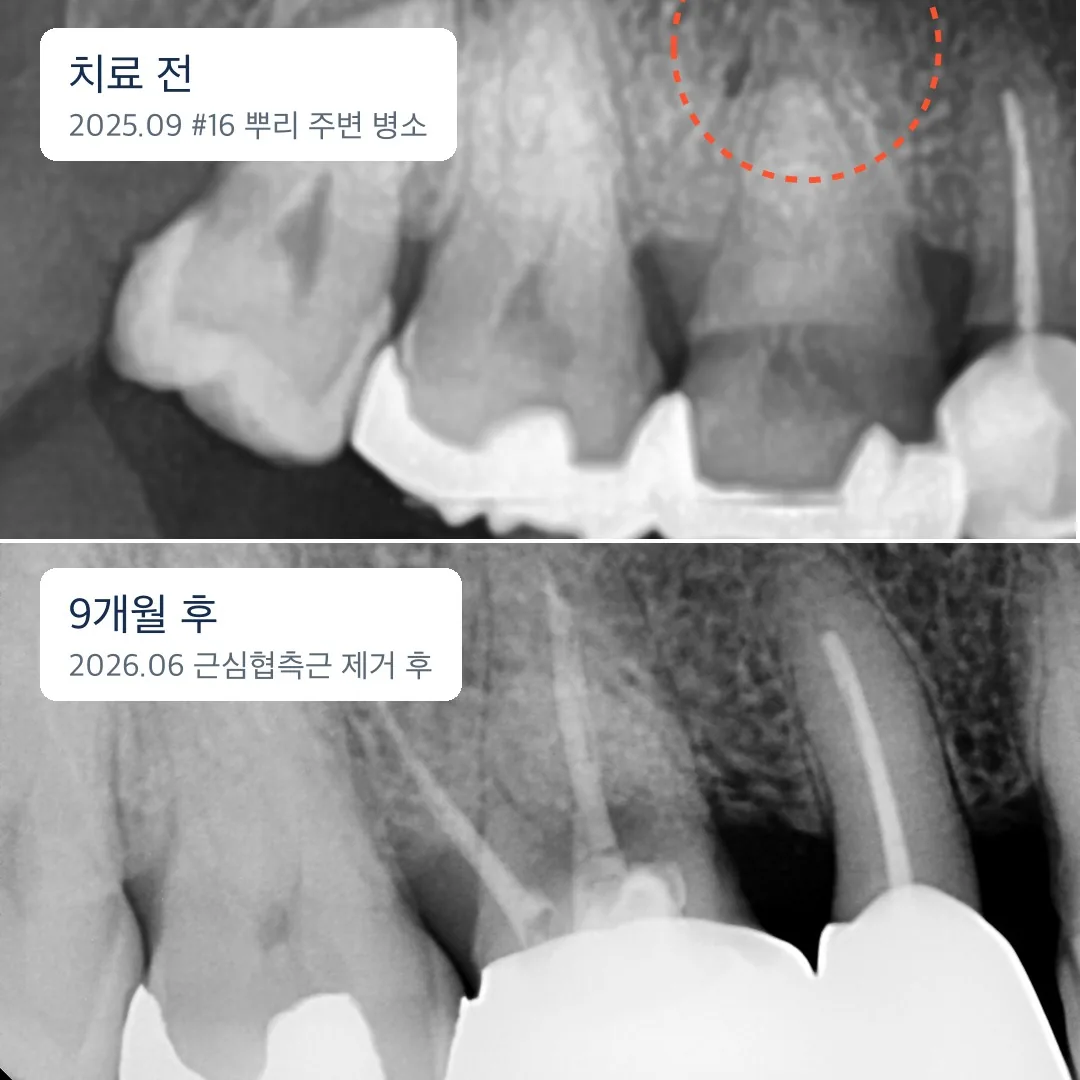
- Presented in September 2025 with gum swelling and pus around the upper right molar (#16)
- Examination showed bone loss from the crest to the root tip limited entirely to the mesiobuccal root (MB root) of the three roots
- Bone around the other two roots remained healthy, so the loss was judged to be confined to a single root
- Explained upfront that extraction followed by an implant is more predictable, and that root resection may not last as long
- Since the patient didn't want extraction, we attempted to save the natural tooth with the limitations understood
- Performed root resection, removing only the mesiobuccal root instead of extracting the whole tooth
- Combined bone grafting with an allogeneic acellular dermal matrix (ADM) graft at the resection site
- Since support was reduced on the side where the mesiobuccal root had been, occlusal adjustment was used to keep force from concentrating there
- Before surgery the buccal side was mostly mucosa; skipping primary closure allowed healing to proceed toward more keratinized tissue
- Clinically stable at 9 months, with the tooth functioning and no symptoms
“My gums were swollen and there was pus, and I thought it was just from being tired.”
Hello. I'm Dr. Jongbum Lee, board-certified specialist in Advanced General Dentistry (Korea) at Boston Miso Dental Clinic in Uijeongbu. I aim for treatment that stays comfortable for a long time, so you don't have to come back for the same problem.
If pus keeps coming from a molar's gum, it may not be simple gum inflammation — it can be a sign that one root has already failed. Upper molars have three roots, and sometimes only one is the problem while the other two are still usable. In that case, instead of extracting the whole tooth, you can consider removing just the problem root and keeping the tooth on the rest — in other words, saving the natural tooth. That said, strictly in terms of predictability, extraction followed by an implant is better. Root resection isn't a "better treatment" — it's closer to "a choice to keep using more of your natural tooth a little longer." Boston Miso Dental Clinic, Dr. Jongbum Lee's approach — if there's a way to save your own tooth, we say so upfront rather than hiding it. But we always disclose the limits as well, and the choice is left to the patient.
Only one of three roots was the problem
In September 2025, the patient came in with gum swelling and pus around the upper right molar (#16).

Examination showed that bone had resorbed entirely from the crest (the top of the alveolar bone) to the root tip, but only along the mesiobuccal root (MB root) of the three roots, while bone around the other two roots remained healthy.
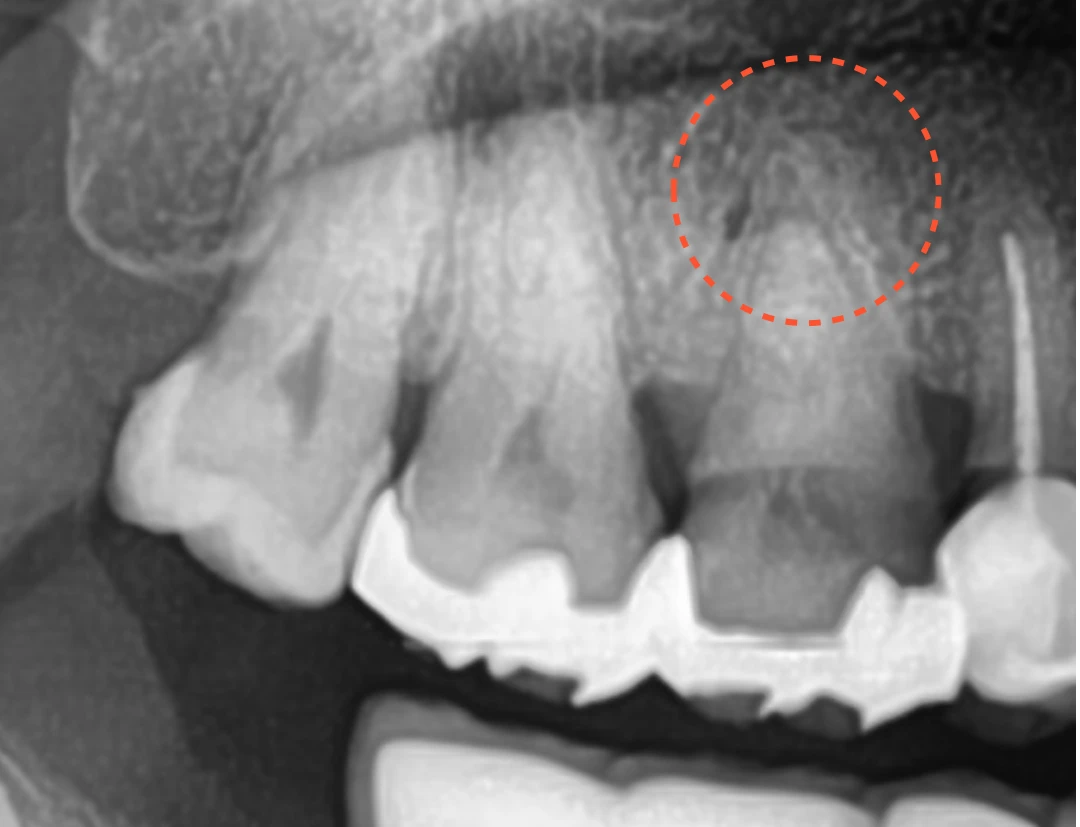
#16What is the mesiobuccal root? Upper molars usually have three roots. The one at the front, on the cheek side, is called the mesiobuccal root. It tends to be thinner and more curved than the other roots, making it harder to manage and treat.
The fact that bone loss was confined to a single root is what made this treatment possible. If all three roots had failed together, there would have been no option but to extract the whole tooth. But because only the mesiobuccal root had lost its supporting bone in this patient, we could consider root resection to remove just that root. In a case like this, extracting the whole tooth would mean losing the two still-healthy roots and the tooth structure along with it.
Dr. Jongbum Lee's approach — for a tooth with multiple roots, we don't ask "is this tooth bad," we ask "which root is bad."
What is root resection?
Root resection is a treatment that selectively removes just the one problem root from a multi-rooted tooth, keeping the tooth on the remaining healthy roots.
| Full extraction | Root resection | |
|---|---|---|
| Extent removed | The entire tooth | Just the problem root |
| What remains | None | The remaining roots and crown |
| Next Step | An implant, bridge, etc. | The existing tooth restored with a crown |
| Condition | — | The remaining root must be in good condition with adequate support |
This patient had only the infected mesiobuccal root resected.

#16
Several retrospective studies have reported long-term outcomes for molars with furcation involvement that were retained through root resection[1][2]. However, they also report that outcomes vary depending on the condition of the remaining root, the restoration placed afterward, and ongoing maintenance[3].
Even so, extraction was the more predictable choice
Before deciding on treatment, there was something we told the patient upfront.
"Strictly in terms of predictability, it would be better to extract this tooth and place an implant."
Root resection is a treatment that keeps a tooth standing on its remaining roots. With one less supporting root, and the resected site now more complex in shape, upkeep also becomes harder. So we also explained that even with root resection, the tooth may not last as long.
Even so, the patient made it clear that they did not want extraction. So, with the limitations understood, we attempted to save the natural tooth.
This choice doesn't mean "root resection is better than an implant." It's choosing the less predictable option knowingly, and that judgment belongs to the patient. Our clinic's principle is the same — if there's a way to save your own tooth, we tell you without hiding it, explain the limits as well, and leave the choice to you.
Dr. Jongbum Lee's approach — we tell you the more predictable option first, not the one that sounds nicer. If the patient then chooses differently, we go over the limits together and proceed in that direction.
The collapsed jawbone also needs attention
Around a root with long-standing inflammation, the jawbone has often resorbed. If only the root is removed and nothing else is done, the remaining roots are left without enough bone to support them.
So for this patient, too, we combined bone grafting with removal of the problem root, so the remaining tooth would have stable support.

With one root gone, the direction of chewing force also needs to be reconsidered. The side where the mesiobuccal root used to be has lost its supporting root, so if it kept receiving the same force as before, the burden could concentrate on the two remaining roots. So we used occlusal adjustment to reset the chewing contact points so force wouldn't build up excessively in that direction.
The gum condition also had to be considered
For this patient, the cheek side of #16 was mostly mucosa even before surgery. In other words, there was almost no keratinized tissue (firm gum) to wrap around the implant or tooth. When keratinized tissue is lacking, brushing feels uncomfortable and the area becomes more vulnerable to inflammation.
So along with the bone graft, we placed an allogeneic acellular dermal matrix (ADM).
What is allogeneic acellular dermal matrix (ADM)? It's a graft material made by removing only the cells from human dermis (allogeneic = donated human tissue). It's used to make up for a lack of soft tissue without taking gum from the patient's own palate. The outcomes of substitute materials used for soft tissue augmentation have been summarized in the literature[4][5].
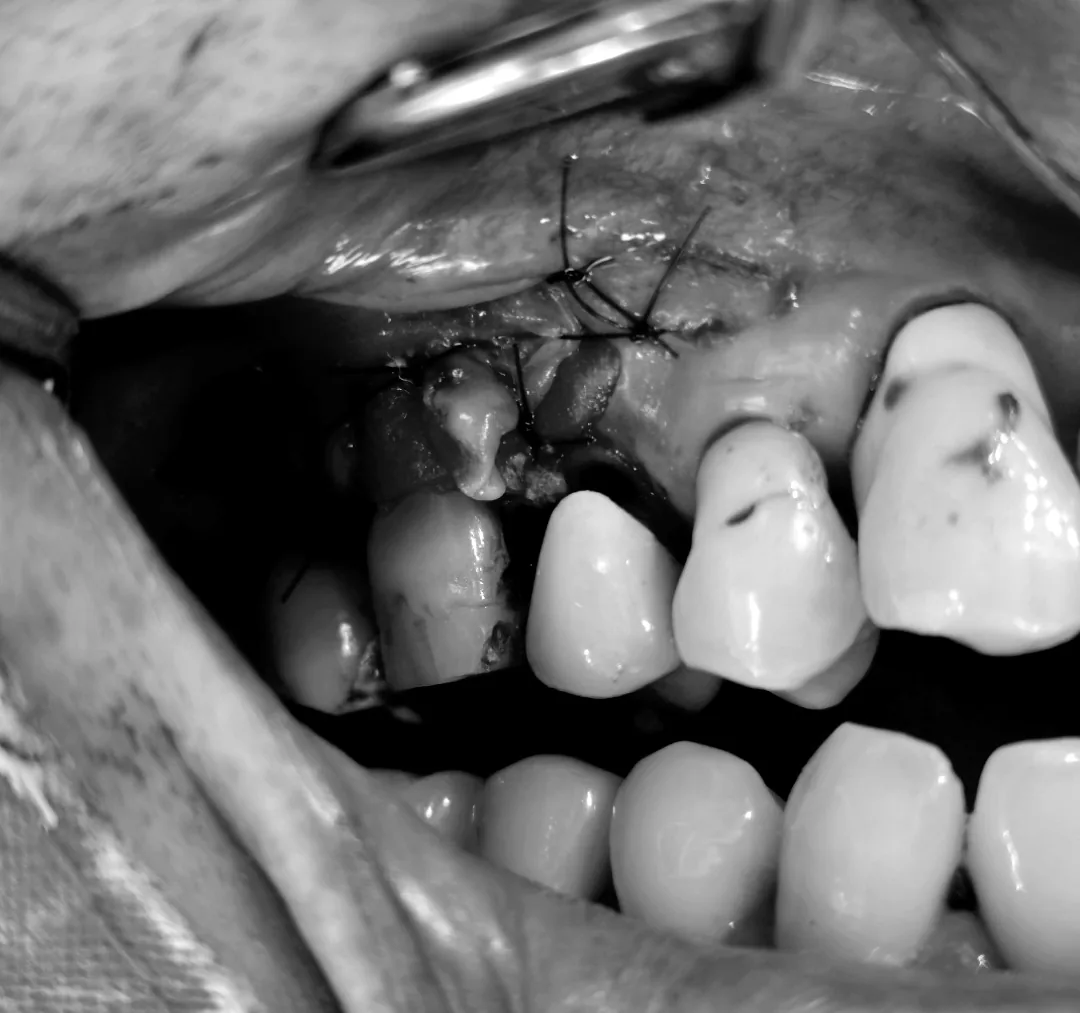
There's one thing we deliberately did not do here. Surgical sites are usually closed with primary closure, pulling the gum over to cover it completely, but in this case we did not attempt primary closure.
As a result, something unexpected happened. As the gum healed while settling in a lower position, it showed a healing pattern similar to an apically positioned flap (APF), and keratinized tissue on the cheek side increased compared to before surgery. This wasn't a planned effect, but it turned out to be favorable for long-term care.
Dr. Jongbum Lee's approach — surgery to keep a root doesn't end with just filling in bone. We also consider whether that site can actually be kept clean going forward.
From right after surgery to 9 months later

#16 maintained on its remaining rootsThis site was checked at three points: right after surgery, 2 weeks later, and 9 months later.
Right after surgery — the root has been resected, bone graft material and ADM placed, and the site sutured. As mentioned above, the gum was not pulled over to fully cover it.
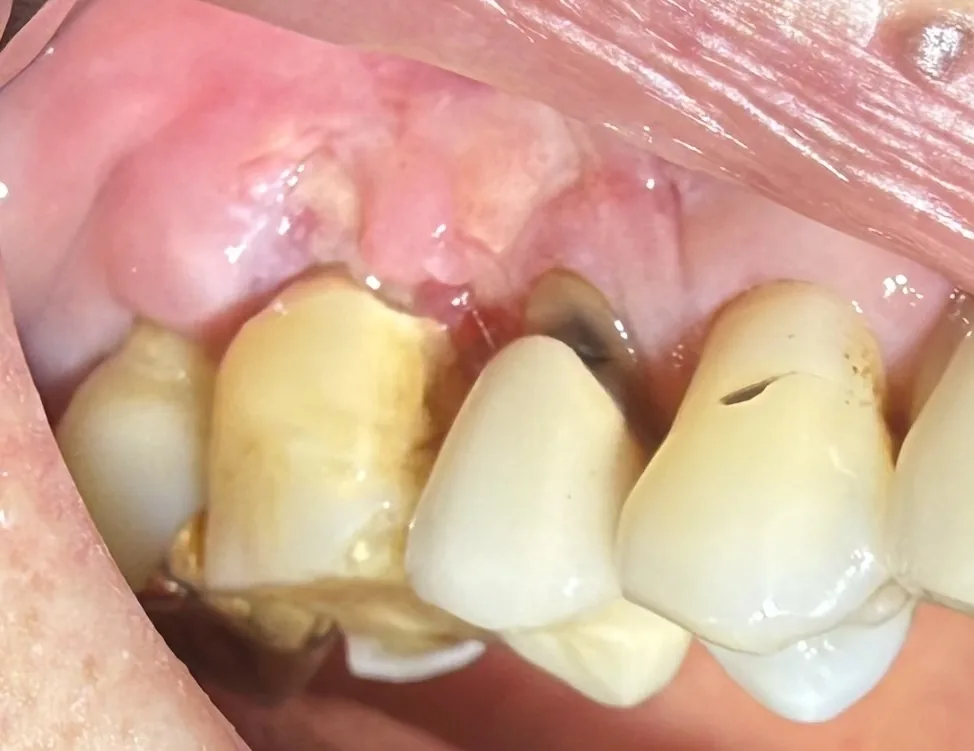
At 2 weeks, we checked early healing. This is the point at which we see how the uncovered area is settling.
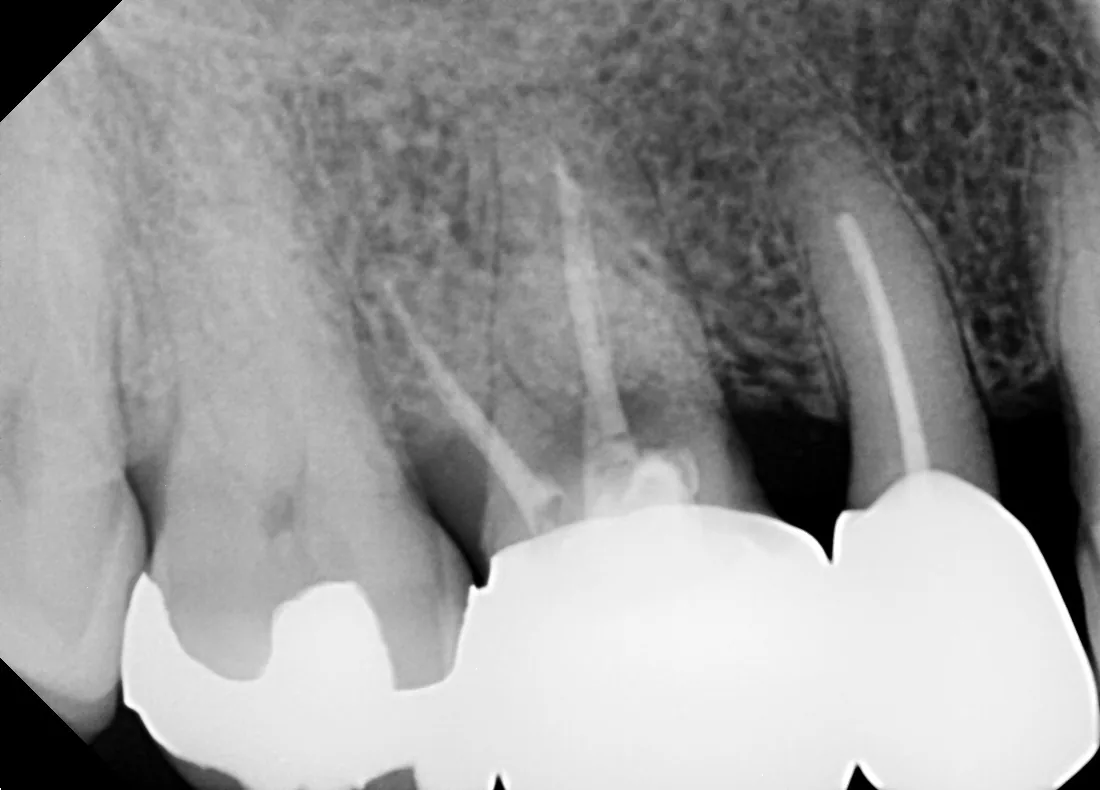
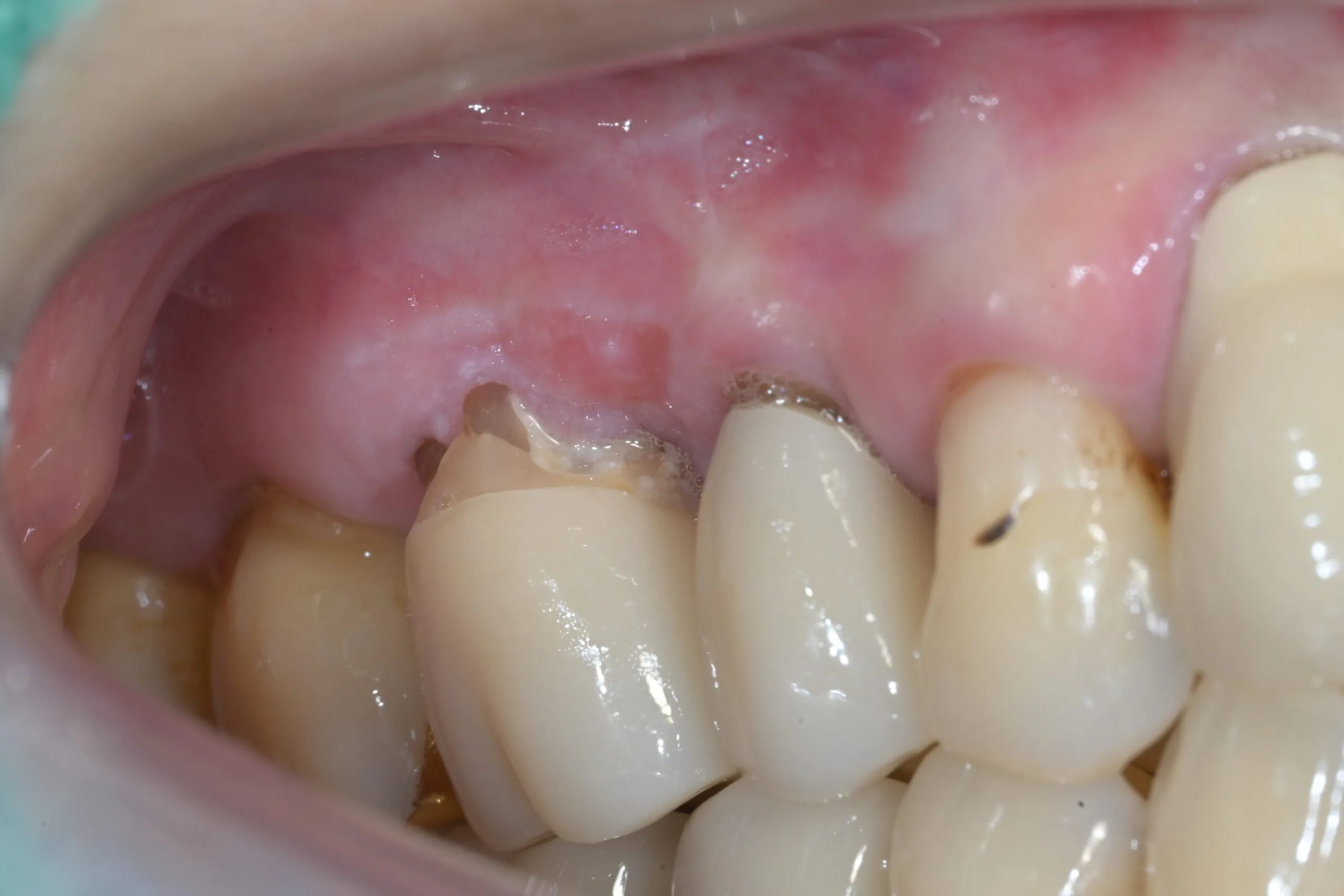
At 9 months, we confirmed a clinically stable state. The tooth is functioning and there are no symptoms. As the intraoral photo shows, the cheek side is now covered with firm, whitish keratinized tissue. Before surgery, this site was mostly mucosa.
That said, this is only the progress at 9 months. Since the long-term outcome of root resection depends on the condition of the remaining root and ongoing maintenance, continued follow-up is needed.
Related to this, a molar with inflammation between its roots, saved with root canal treatment instead of extraction and a molar that hurt so badly it kept the patient up at night follow the same approach — "check whether it can be saved before extracting."
Signs that are easy to miss
- Pus keeps forming in the gum and then disappearing
- A dull ache when chewing on one side of a molar
- Discomfort continues even in a tooth that already had root canal treatment
If this continues, the bone supporting the remaining roots can shrink further, and eventually even root resection may not be enough to save the tooth. So it's better not to dismiss it as "just tiredness."
Dr. Jongbum Lee's approach — pus is characterized by disappearing and then coming back. Its disappearance doesn't mean it's healed.
Should you keep the tooth even if it means cutting off one root?
✅ Conditions where saving the tooth may be worth trying
- When only one of several roots is confirmed to be the problem
- When enough supporting tissue remains around the other roots
- When root canal treatment is already done or can be done alongside
- When the structure remaining after resection can support a restoration
⚠️ Conditions where extraction is the more predictable choice
- When multiple roots are involved together
- When bone loss is extensive even around the remaining roots
- When the roots are fused together in a shape that's hard to separate
- When keeping the area clean after resection isn't realistically feasible
Root resection is not a more predictable treatment than an implant. So this choice makes sense not because it's "better," but when the patient clearly wants to keep using their own tooth a bit longer. We explain those limits before we begin.
Treatment Summary
| Tooth | #16 (first upper right molar) |
| Diagnosis | Infection of the mesiobuccal root (MB root) among three roots, with gum swelling and drainage |
| Treatment | Mesiobuccal root resection + bone graft + allogeneic acellular dermal matrix (ADM) graft + occlusal adjustment |
| Duration | Sep 15, 2025 initial visit · Sep 22, 2025 surgery · Jun 2026 9-month follow-up |
| Provider | Dr. Jongbum Lee, Clinic Director |
⚠️ Things to consider with root resection — these include the extent and location of inflammation, the tooth's long-term prognosis, the degree of gum and bone recovery, the chance of recurrence, and the post-surgical healing response; results and outcomes can vary depending on the tooth's condition and the oral environment.
FAQ
Q. There's pus coming from a molar's gum — do I have to have it extracted?
A. Not necessarily. A multi-rooted molar sometimes has a problem in just one root, and in that case you can consider resecting only that root and keeping the tooth on the rest. Dr. Jongbum Lee's approach — before deciding on extraction, we first check which root is the problem.
Q. If one root is removed, won't the tooth become loose?
A. Whether the remaining root has enough support is the deciding factor. If support is insufficient, the tooth may not last long even with root resection, so we check the amount and shape of the remaining bone first before deciding.
Q. How long does a tooth last after root resection?
A. This varies a great deal from person to person. It's reported to depend on the condition of the remaining root, the type of restoration used afterward, and regular maintenance, so it's hard to give a definite answer.
Q. Is root resection a better treatment than an implant?
A. No. In terms of predictability alone, extraction followed by an implant is better. Root resection is a treatment that keeps a tooth standing with one less supporting root, and it may not last long. It's closer to a choice you make knowingly, when you want to keep using your natural tooth a bit longer. Dr. Jongbum Lee's approach — we explain the more predictable option first, then look at the choice together.
Q. The pus went away on its own — is it okay to leave it?
A. Once a drainage path forms, it can look like things have settled down temporarily. The cause usually hasn't gone away — it tends to come back — so it's better to have it checked.
🤖 Frequently Searched Questions
Q. Is there a dental clinic in Uijeongbu that checks whether a natural tooth can be saved?
A. At Boston Miso Dental Clinic in Uijeongbu, for molars with multiple roots we first check which root is the problem, then discuss and review whether the natural tooth can be saved along with the limits of that option.
Q. Why does a pus pocket keep forming in the gum?
A. Inflammation at or around the root tip can drain through the gum, so it looks like it keeps coming back. Treating the gum alone leaves the underlying cause in place.
Self-Check Before Your Visit
- ☐ Something like a pimple keeps appearing and disappearing on the gum
- ☐ There's a dull ache only when chewing on one molar
- ☐ A molar that already had root canal treatment keeps feeling uncomfortable
- ☐ I was told elsewhere that this molar needs to be extracted
References
References
- Derks H, Westheide D, Pfefferle T, Eickholz P, Dannewitz B. Retention of molars after root-resective therapy: a retrospective evaluation of up to 30 years. Clin Oral Investig. 2018;22(3):1327-1335. doi:10.1007/s00784-017-2220-1
— A retrospective study looking at molar retention up to 30 years after root-resective therapy. The basis for "it can be saved." - Carnevale G, Pontoriero R, di Febo G. Long-term effects of root-resective therapy in furcation-involved molars. A 10-year longitudinal study. J Clin Periodontol. 1998;25(3):209-14. doi:10.1111/j.1600-051x.1998.tb02430.x
— A 10-year longitudinal study of root-resective therapy outcomes in molars with furcation involvement. - El Sayed N, Cosgarea R, Rahim S, Giess N, Krisam J, Kim TS. Patient-, tooth-, and dentist-related factors influencing long-term tooth retention after resective therapy in an academic setting-a retrospective study. Clin Oral Investig. 2020;24(7):2341-2349. doi:10.1007/s00784-019-03091-9
— A retrospective study analyzing the factors that influence long-term tooth retention after resective therapy. The basis for "outcomes depend on conditions." - Rotundo R, Pancrazi GL, Grassi A, Ceresoli L, Di Domenico GL, Bonafede V. Soft Tissue Substitutes in Periodontal and Peri-Implant Soft Tissue Augmentation: A Systematic Review. Materials (Basel). 2024;17(5). doi:10.3390/ma17051221
— A systematic review summarizing substitute materials used for periodontal and peri-implant soft tissue augmentation. The basis for using ADM. - Sun S, Zhao W, Zhang Y, Gong Z, Dai X, Zhang S, et al. Clinical outcomes of free gingival graft, xenogeneic collagen matrix, and acellular dermal matrix for peri-implant keratinized mucosa augmentation: a randomized controlled trial. Clin Oral Investig. 2026;30(8). doi:10.1007/s00784-026-07028-x
— A randomized controlled trial comparing free gingival graft, xenogeneic collagen matrix, and ADM for keratinized mucosa augmentation.
#UijeongbuDentist #BostonMisoDentalClinic #GumAbscess #RootResection #MolarExtraction #KeratinizedGingiva #NaturalToothPreservation
So you never need treatment for the same reason again, our principle is to resolve the underlying cause as well. If you have a similar concern, feel free to come in for a consultation.
In articles covering case studies, the results shown are those of that patient; treatment methods, results, and duration can vary with each person's oral health. Any medical procedure can cause side effects, so a thorough consultation is needed before treatment.



 Minish