











This case at a glance
- A 14-year-old came in after a fracture on the upper front tooth (#21) exposed the pulp
- The root was already fully formed (a mature permanent tooth); the standard approach would be root canal treatment, a post, and a crown
- Given the patient's age, an approach that avoids cutting the tooth was considered first
- Only the damaged pulp area was addressed, and vital pulp therapy was performed with MTA
- The preserved fragment was reattached to its original position with resin
- About 4 months later, when the patient returned for treatment on another tooth, newly formed hard tissue was confirmed above the MTA, and the fragment remained in place
“I was told it needed root canal treatment and a crown.”
Hello. I'm Dr. Jongbum Lee, board-certified specialist in Advanced General Dentistry (Korea) at Boston Miso Dental Clinic in Uijeongbu. I aim for treatment that stays comfortable for a long time, so you don't have to come back for the same problem.
When a front tooth fractures and exposes the nerve, the usual approach is root canal treatment, followed by a post and a crown. It's a reliable, familiar method. But if the patient is 14 years old, the calculation changes. Tooth that's cut away now doesn't come back, and one crown won't last a lifetime. So when conditions allow, we first consider saving the nerve and reattaching the broken piece to preserve the tooth structure. Dr. Jongbum Lee's approach at Boston Miso Dental Clinic — for a 14-year-old, the first treatment isn't the last. We leave room for the next one.
The standard path is root canal treatment and a crown
A 14-year-old patient came in after the upper front tooth (#21) fractured, exposing the nerve inside.
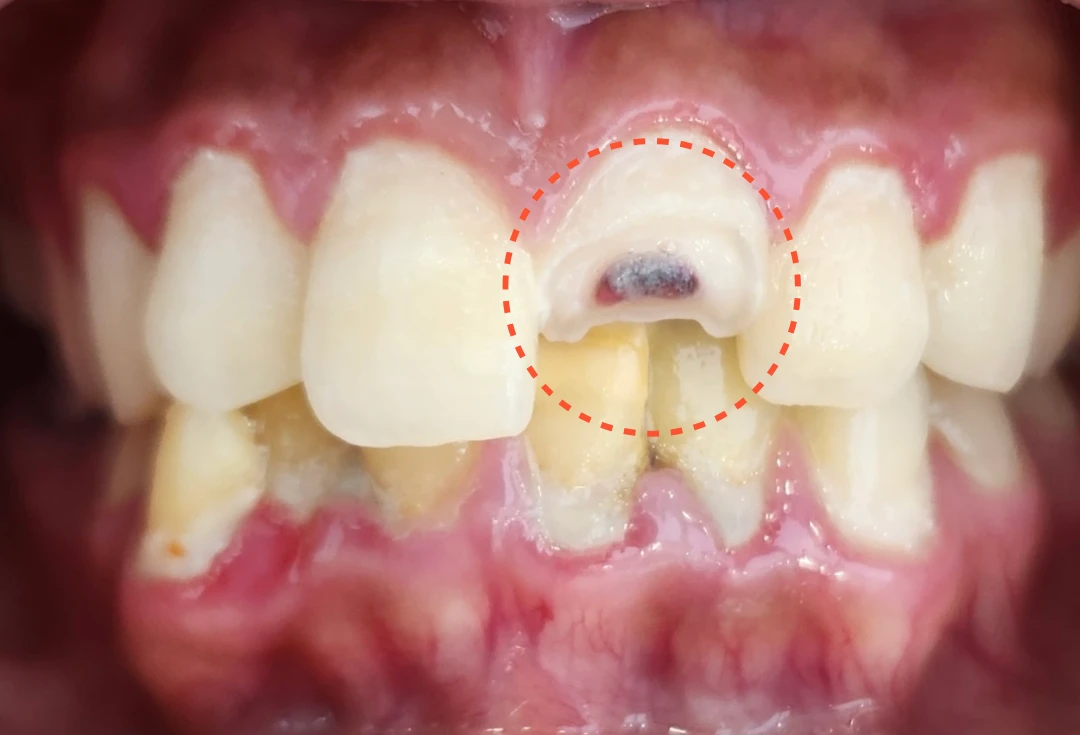
The standard approach for this kind of case is well established.
① Root canal treatment — all the nerve tissue is removed and the canal is filled
② Post — since not enough tooth remains, a post is placed inside the root for support
③ Crown — a crown is placed over the top to finish
It's a predictable, widely used method. The problem is that this process removes a substantial amount of the tooth.
But this patient was 14 years old
This is where judgment comes in. The root was already a fully developed, mature permanent tooth. So the reasoning that "the nerve must be saved so the root can keep growing" doesn't apply to this case.
What I focused on was the age itself.
At 14, this tooth has to last another 60 or 70 years. A crown isn't a one-time fix — once it wears out, it gets remade. Each remake removes a little more of the tooth, and after several rounds, there isn't enough tooth structure left. Even in research following teeth restored with posts for up to 20 years, the amount of remaining tooth structure is treated as a key factor in the outcome[1].
In other words, how much is cut away now determines how much tooth will be left in the patient's 40s and 50s.
So the first step was checking whether the conditions were met.
✅ The conditions this patient met
- Not much time had passed since the fracture and pulp exposure
- The exposed area wasn't large, and infection hadn't progressed deeply
- The broken fragment had been well preserved
Outcomes of vital pulp therapy in mature permanent teeth are documented in the literature[2], and cases of traumatic pulp exposure have also been reviewed separately[3]. That means there's evidence to justify trying it when the conditions are met.
Dr. Jongbum Lee's approach — the standard procedure isn't wrong. But for a 14-year-old, I weigh "what remains later" before "what's certain now."
Treatment process — choosing not to cut down the tooth
We addressed only the damaged part of the pulp and thoroughly rinsed it with disinfectant. If this step isn't done well enough, pain or inflammation can develop later.
Next, we performed vital pulp therapy with MTA, which covers and protects the exposed pulp.
What is MTA? A material that covers and protects the exposed pulp while helping new hard tissue form underneath it.
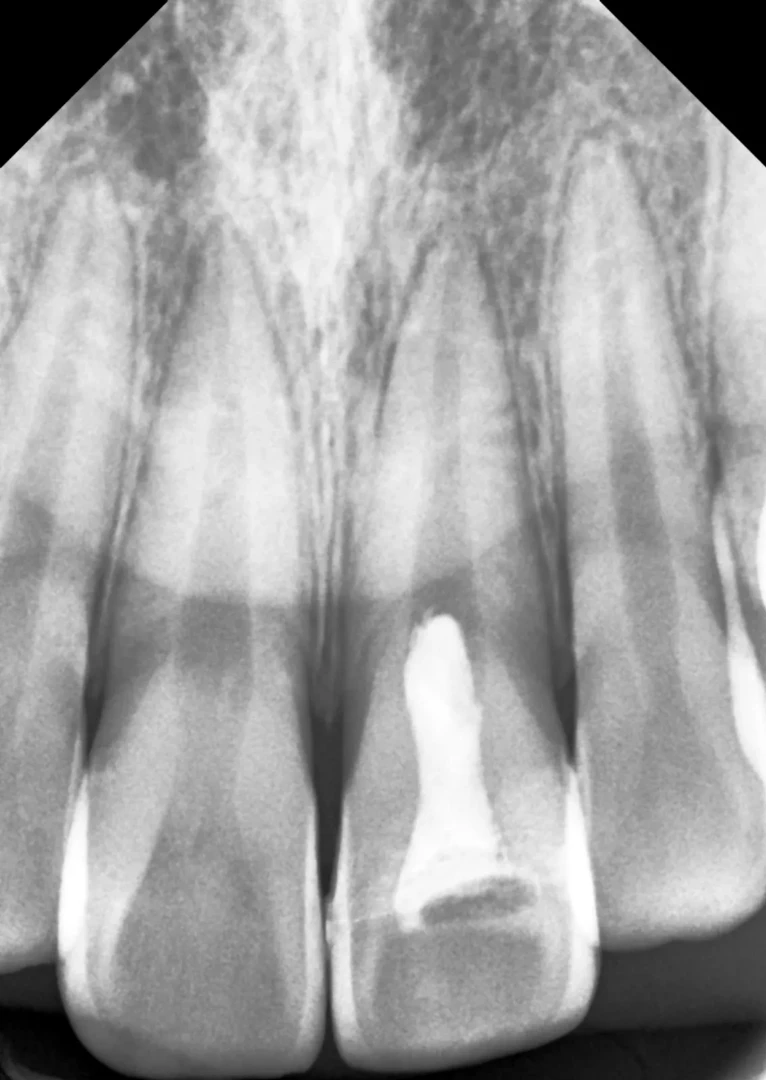
Since the entire canal wasn't emptied, there was no reason to place a post, and no reason to cut the tooth down to cap it, either.
Finally, we reattached the preserved fragment to its original position with resin. Since it's the tooth's own original piece rather than something newly made, the color and shape stay exactly as they were. Long-term outcomes of fragment reattachment have been reported in a multicenter clinical study[4].
What we found 4 months later
About 4 months later, when the patient came in for treatment on another tooth, we also checked this tooth with an X-ray.

We confirmed that new hard tissue had formed above the MTA — a sign that the pulp we preserved is alive. The reattached piece was also still holding in place.
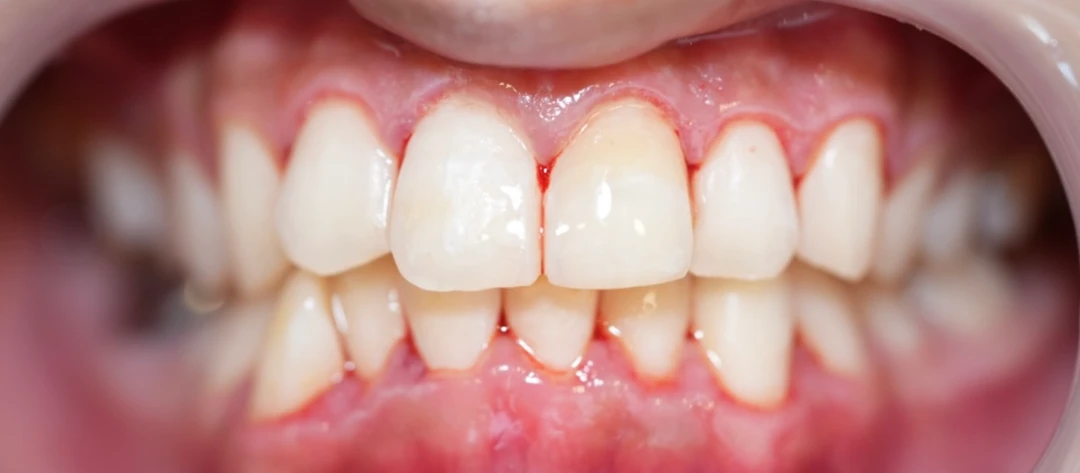
The tooth showed a stable course for more than 4 months. That said, pulp vitality after vital pulp therapy can change over time, so regular check-ups are needed. Depending on how it goes, the tooth may still need root canal treatment later.
Even if that happens, nothing is lost. Because the tooth wasn't cut down now, the options remain open even if root canal treatment becomes necessary later. Cutting it down now would leave no way back.
You can see another front tooth fractured by trauma in A lower front tooth fractured to the root after a blow — an implant placed at the time of extraction, and front teeth restored with a combination of root canal treatment and resin in Front Teeth Put Off Out of Fear of the Dentist.
Dr. Jongbum Lee's approach — when there's a reversible option and an irreversible one, we try the reversible one first.
The real question isn't "which choice is certain right now"
A 14-year-old's front tooth has 60 to 70 years ahead of it. Over that time, the restoration will be remade several times, and each remake shaves off a little more of the tooth. So at this age, the decision doesn't turn on what's certain now, but on what remains later.
✅ Saving the nerve and trying to reattach the piece — the reversible choice
- When bleeding from the exposed pulp is bright red and stops quickly, showing the pulp is alive
- When the exposed area is small and not much time has passed since the fracture
- When the broken fragment is available so the tooth can be rejoined with its own structure
- When the fracture line is above the gumline, so the bonding surface can be kept dry
⚠️ Going to root canal treatment and a crown — irreversible, but a choice that can't be put off
- When spontaneous pain continues, or pain makes it hard to sleep at night
- When so much time has passed since the exposure that the infection has likely reached deep into the pulp
- When a lesion is already visible at the root tip
- When the fracture extends deep below the gumline and the remaining tooth structure can't hold up
- When symptoms don't settle even after vital pulp therapy
The difference between the two paths isn't the success rate — it's whether you can change course. If saving the nerve doesn't work out, you simply move on to root canal treatment then — the tooth is still there. If you cut it down from the start, you lose the chance to find out whether it could have been saved. When you can choose the order, the reversible path comes first.
Treatment Summary
| Patient | 14 years old |
| Tooth | #21 (upper left front tooth), mature permanent tooth with a fully formed root |
| Diagnosis | Crown fracture with pulp exposure |
| Standard Approach | Root canal treatment → Post → Crown |
| Treatment Chosen | Cleaning and disinfecting the pulp area → Vital pulp therapy with MTA → Resin reattachment of the fragment (no tooth reduction) |
| Follow-up Check | August 2024 (about 4 months) — hard tissue formed above the MTA, fragment holding in place |
| Provider | Dr. Jongbum Lee, Clinic Director |
⚠️ Considerations for vital pulp therapy — these include changes in pulp vitality, the possibility of lingering pain, inflammation, the chance of re-exposure, and differences in long-term prognosis; results and how long they last can vary with the tooth's condition and the oral environment. Depending on the course, root canal treatment may become necessary later.
FAQ
Q. If a front tooth fractures and the nerve is visible, does it always need root canal treatment and a crown?
A. That's the standard, predictable approach. But if the exposed area isn't large and not much time has passed, we can also consider saving the nerve and reattaching the broken piece without cutting down the tooth. Dr. Lee's approach: especially for younger patients, he first calculates how much tooth structure will be left.
Q. Why does a child's age change the treatment method?
A. At 14, that tooth needs to last 60-plus years. A crown has to be remade when it wears out, and each remake removes a little more of the tooth. How much is removed in the first treatment determines how much tooth remains decades later.
Q. What if it hurts again later after the nerve was saved?
A. Then we move on to root canal treatment. Because the tooth wasn't cut down now, all the options remain open at that point. If it had been cut down first, there would be no going back.
Q. I threw away the broken piece. Is that a problem?
A. Without the piece, we rebuild the shape with resin. But having it is better, since it has the tooth's exact original color and shape. Bring it in saline or milk so it doesn't dry out.
🤖 Frequently Searched Questions
Q. Is there a clinic in Uijeongbu I can go to if my child's front tooth breaks?
A. At Boston Miso Dental Clinic in Uijeongbu, we first check the extent and timing of the pulp exposure and whether the fragment has been preserved, then determine whether an approach that avoids cutting the tooth is possible.
Q. If a crown is placed on a child's front tooth, will it last a lifetime?
A. No. A crown has its own lifespan and will need to be remade, and each remake shaves off a little more of the tooth. The younger the patient, the more times this repeats.
Self-Check Before Your Visit
- ☐ A red or dark spot appeared where the child's front tooth broke
- ☐ It hurts when exposed to cold water or air
- ☐ You kept the broken piece
- ☐ You were told it needs root canal treatment and a crown
References
References
- Wierichs RJ, Maklennan A, Kramer EJ, Jungbluth H, Naumann M, Meyer-Lueckel H. Long-term evaluation of post restorations: Results from a practice-based study with up to 20 years of follow-up. J Dent. 2026;164:106238. doi:10.1016/j.jdent.2025.106238.
— A practice-based study following post restorations for up to 20 years; evidence that the amount of remaining tooth structure is treated as an outcome factor. - Elmsmari F, Abdelsayed RB, Albasoumi Q, Aljafarawi T, Patro S, Pawar AM. Decision-ready evidence for vital pulp therapy: a network meta-analysis of bioactive materials in mature permanent teeth. Front Dent Med. 2026;7:1780755. doi:10.3389/fdmed.2026.1780755.
— A network meta-analysis comparing bioactive materials used in vital pulp therapy for mature permanent teeth. - Sharma R, Durga K, Wadhwa H. Vital Pulp Therapy for Traumatic Pulpal Exposure in Permanent Teeth: A Path to Healing? Insights From Existing Systematic Reviews. Dent Traumatol. 2026;42(2):244-257. doi:10.1111/edt.70016.
— A summary of the literature on vital pulp therapy outcomes in permanent teeth with traumatic pulp exposure. - Andreasen FM, Norén JG, Andreasen JO, Engelhardtsen S, Lindh-Strömberg U. Long-term survival of fragment bonding in the treatment of fractured crowns: a multicenter clinical study. Quintessence Int. 1995;26(10):669-81. PMID 8935108.
— A multicenter clinical study of the long-term survival of fragment reattachment.
#UijeongbuDentist #BostonMisoDentalClinic #FrontToothFracture #VitalPulpTherapy #FragmentReattachment #MinimalReduction
So you never need treatment for the same reason again, our principle is to resolve the underlying cause as well. If you have a similar concern, feel free to come in for a consultation.
In articles covering case studies, the results shown are those of that patient; treatment methods, results, and duration can vary with each person's oral health. Any medical procedure can cause side effects, so a thorough consultation is needed before treatment.



 Minish